


MÜLLER Steel & Welding Technology
Welding Technology
Secure connections for long-lasting stability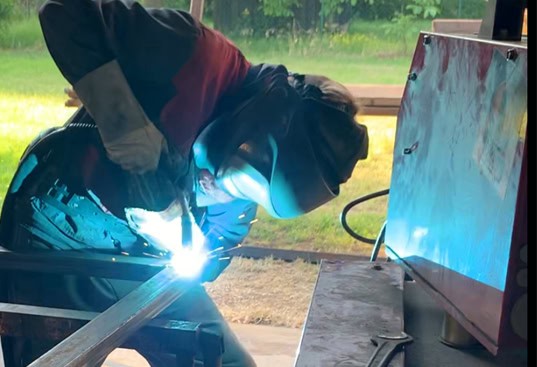
From custom designs to complex projects—Stahlbau Müller is your trusted partner for innovative steel solutions.
Joining metals by fusing them together: Depending on the intended use and the materials to be joined, we employ a wide range of different welding processes in our workshop.
At the Manual arc welding An electric arc serves as the heat source. This arc burns between a coated electrode and the workpiece. This causes the base material to melt, while the core wire and the coating of the electrode melt and drip down. The process is suitable for unalloyed and alloyed steels, sheet metal, sections, and pipes with a workpiece thickness of three millimeters or more in all positions.
At the Gas Metal Arc Welding (MSG) are fed to the welding torch through the hose assembly, along with shielding gas, welding current, and the wire electrode. The welding current enters the wire electrode via a sliding contact in the current contact tube. This creates an arc that burns between the workpiece and the wire electrode. The wire electrode melts in a droplet-like manner under the shielding of the flowing shielding gas.
This process involves alloyed and unalloyed steels with inert gas welded (Metallaactive-Gwelding (MAG), while for aluminum and other non-ferrous metals Inert shielding gas used (MMetal-Inertg(TIG, MIG). With gas metal arc welding, workpieces with thicknesses ranging from 0.6 mm to 100 mm can be welded in any position.
At the Tungsten Inert Gas Welding (TIG) involves a non-consumable tungsten electrode clamped in the welding torch, through which the welding current is passed. An arc forms between the tungsten electrode and the workpiece, melting the base material and the manually fed filler metal. The inert shielding gas flowing from the welding torch protects the weld pool from the effects of the atmosphere. TIG welding is used for unalloyed and alloyed steels, aluminum, and other non-ferrous metals, as well as in any application where high weld quality is required.